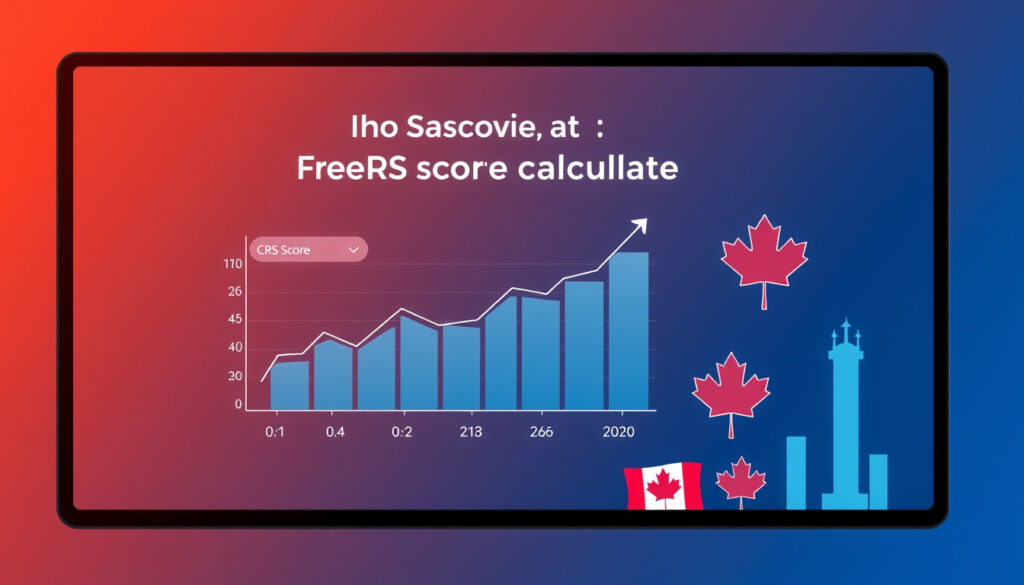
Express Entry Score Calculator: Free CRS Tool 2026
Express Entry CRS cutoffs in 2026 have swung from 169 to 786 depending on the draw category — making it impossible to gauge eligibility without a reliable calculator and verified draw data. This guide walks through the free tools that actually work, what the 2026 draw data shows, and how to use those scores to make a realistic plan.
Official CRS tool provider: canada.ca · Key CRS factors: age, work experience, language, education · Recent draw focus: 2026 projections · Free calculators: canadavisa.com, moving2canada.com · Sample score queries: 450, 470 CRS
Quick snapshot
- IRCC held 23 draws between January 5 and April 15, 2026, issuing 65,154 ITAs (Amir Ismail)
- Official CRS tool available at canada.ca (IRCC Canada.ca)
- Draw #411 on April 15, 2026: French proficiency draw, 4,000 ITAs, CRS 419 (IRCC Canada.ca)
- Exact CRS cutoffs beyond April 15, 2026 — official IRCC data only confirmed through that date (Amir Ismail)
- Whether 2026 immigration levels plan targets will shift draw frequency or volume (Moving2Canada)
- Draw #397 Physicians: record-low CRS 169 on February 19, 2026 (Amir Ismail)
- Draw #405 French proficiency: CRS 393 on March 18, 2026 (CanadaVisa)
- Next predicted draw: April 27, 2026, PNP type, CRS 755+ (Moving2Canada)
- Predicted next PNP draw could require CRS 755+ based on 2026 pattern (Moving2Canada)
- French language proficiency draws likely to continue with lower thresholds (Moving2Canada)
Key CRS score facts across the main draw categories and official calculator options are summarized below.
| Field | Value |
|---|---|
| Official calculator URL | https://www.canada.ca/en/immigration-refugees-citizenship/services/immigrate-canada/express-entry/check-score.html |
| Top CRS factors | work experience, age, occupation, education, language proficiency |
| Popular score checks | 450, 470 points |
| 2026 focus | New TR to PR pathway |
Can I calculate my CRS score for free?
Yes, and the official tool from IRCC is completely free. The IRCC Comprehensive Ranking System tool (IRCC’s official CRS calculator) lets you enter your age, education, work experience, and language test results to get your score instantly — no account needed.
Official government tool
The government calculator covers all core CRS factors and gives you the same 1,200-point framework used in actual draws. It won’t tell you when you’ll be invited, but it accurately reflects how IRCC scores your profile.
Third-party free calculators
Several established immigration sites offer free CRS calculators with extra features:
- CanadaVisa CRS calculator — free tool from one of Canada’s largest immigration platforms
- Moving2Canada CRS calculator — compares your score against recent draw cutoffs, useful for gauging competitiveness
- Immigration.ca — free CRS tool covering age, education, work, and language factors
Using the official IRCC tool first establishes a baseline. Third-party calculators can add context by showing how your score stacks up against actual draw results — but always verify against canada.ca for accuracy.
What’s a good Express Entry score?
A “good” score depends entirely on which draw category you’re targeting. The CRS benchmarks vary wildly between program types, and the 2026 data makes that gap impossible to ignore.
Current draw cutoffs
Based on verified draw results through April 15, 2026:
- CEC draws: 507–515 range in Q1 2026, targeting 530+ for the year (Moving2Canada)
- PNP draws: consistently 700+ and above, with Draw #409 hitting CRS 786 on April 13, 2026 (CanadaVisa)
- French proficiency draws: 393–419 in 2026, with 400+ as the target threshold (Moving2Canada)
- General draws: 570+ target CRS for 2026 (Moving2Canada)
Factors influencing good score
The Comprehensive Ranking System awards points across four sections: core human capital factors (age, education, language ability, Canadian work experience), spouse or common-law partner factors, skill transferability, and bonus points for things like provincial nominations or job offers. Immigration.ca breaks down how each factor contributes to your total.
The average CRS cutoff across all 23 draws through mid-April 2026 sat at 554, according to SoonToBeCanadian — but that number masks the wide gap between category-specific floors and ceilings.
The implication: a score that looks strong against the overall average may still fall short of your specific draw category’s cutoff, so always benchmark against category-specific data rather than the aggregate.
Is 450 a good score for Express Entry?
A score of 450 sits below most standard Express Entry cutoffs in 2026, but it doesn’t rule you out — it depends on which pathway you’re targeting.
Comparison to recent draws
Looking at actual 2026 results, a 450 CRS would fall short of:
- CEC draws (507–515 range)
- PNP draws (700+ required)
- General draws (570+ target)
However, 450 would be competitive for French proficiency draws — Draw #405 on March 18, 2026 invited candidates at CRS 393 (CanadaVisa). Improving your French language proficiency could push a 450-score profile into invitation range for that category.
Improvement strategies
If your CRS is below 450, key levers include: boosting language test scores (especially French if you have any proficiency), gaining another year of skilled work experience, pursuing a provincial nomination (which adds 600 points), or completing a post-secondary credential in Canada.
What this means: candidates scoring 450 should treat French proficiency as the fastest route to an invitation, since that category’s floor sits well below general and CEC thresholds.
Can I get PR with 470 CRS score?
A 470 CRS score puts you in a different situation than 450 — you’re closer to several invitation categories, though still below most CEC and general draws.
Draw history review
Draw #408 on April 2, 2026 invited 3,000 trades workers at CRS 477 (CanadaVisa). That trade-specific draw sits just above 470, which means a 470-score candidate with trades experience could have qualified. The first 2026 CEC draw on January 7, 2026 issued 8,000 ITAs at CRS 511 — well above 470, as noted by Bartlaw Immigration.
2026 outlook
The 2026 immigration levels plan projects continued high volumes — 65,154 ITAs already issued through April 15 across 23 draws (Amir Ismail). For 470-score candidates, the best bets are French proficiency draws (which have dipped into the 390s) or trades category draws. A provincial nomination remains the fastest route to surpassing the 700-point PNP threshold.
The catch: without a trades background or French skills, a 470-score candidate needs either a provincial nomination or a significant score improvement to stay competitive through year-end.
Will the CRS score go below 500 in 2026?
Already has — repeatedly. The question isn’t whether scores will drop below 500, but which categories will drive those lows.
2026 draw predictions
The record-low CRS of 169 was set in the Physicians draw on February 19, 2026 (Amir Ismail). French proficiency draws have consistently run lower, with CRS 393 on March 18 and CRS 419 on April 15, 2026. These category-based draws show that when IRCC targets specific labor market needs, cutoffs can plummet well below 500.
New pathways impact
The new TR to PR pathway announced for 2026 has excluded major Canadian cities from eligibility, which may shift application patterns. Draws occur approximately every two weeks, according to CanadaVisa, and the predictable rhythm means you can plan your profile improvements around the draw calendar.
What this means: CRS below 500 is already happening in 2026 — but only in category-based draws targeting physicians, French speakers, or trades workers. General and CEC draws remain above 500, so unless you qualify for a specialized category, a 500+ score is still the realistic benchmark.
IRCC held 23 Express Entry draws between January 5 and April 15, 2026, issuing 65,154 ITAs. The average cutoff across those draws was 554 — so if your calculator score is well below that, consider which specialized categories might work better than waiting for a general draw.
How to use an Express Entry score calculator
Using a CRS calculator effectively means understanding what it tells you — and what it doesn’t. Here’s the step-by-step process. Descobreix com els retalls de la Comprehensive Ranking System (CRS) d’Express Entry han fluctuat des de 169 fins a 786 el 2026, fent impossible avaluar l’elegibilitat sense una calculadora fiable i dades verificades dels sorteigs, i aprèn a utilitzar aquestes puntuacions amb les eines gratuïtes que funcionen a Calculadora de crèdit fiscal per al carboni.
- Gather your documents first. You’ll need language test results (IELTS, CELPIP, TEF, or TCF), your educational credentials, and your work experience letters.
- Start with the IRCC official tool. Enter your age, education level, official language proficiency scores, and Canadian work experience. The tool calculates your core human capital score out of 500 points.
- Add spouse or partner details if applicable. This affects the spouse accompaniment points section, which can shift your total.
- Factor in skill transferability. Your education combined with official language ability and foreign work experience creates additional points in this section.
- Check bonus points. Provincial nominations (600 points), job offers (50 or 200 points), and French language ability (30 points) can dramatically change your total.
- Compare against actual draws. Use a third-party calculator like Moving2Canada to see how your score stacks up against recent draw results for each category.
IRCC held 23 draws between January 5 and April 15, 2026, issuing 65,154 ITAs. The average cutoff across those draws was 554 — so if your calculator score is well below that, consider which specialized categories might work better than waiting for a general draw.
Express Entry Draw Timeline: 2026 Highlights
Seven key moments from the first four months of 2026 Express Entry draws, based on verified IRCC and tracker data.
The pattern is clear: category-based draws dominate 2026, with CRS cutoffs swinging from 169 to 786 depending on the program type.
| Date | Draw Type | ITAs | CRS Cutoff |
|---|---|---|---|
| CEC | 8,000 | 511 | |
| Physicians | 391 | 169 | |
| French proficiency | 4,000 | 393 | |
| CEC | 2,250 | 509 | |
| Trades | 3,000 | 477 | |
| PNP | 324 | 786 | |
| French proficiency | 4,000 | 419 |
General draws remain sparse, pushing applicants toward specialized pathways or provincial nominations.
What we know vs. what’s still uncertain
High confidence exists around official draw data, while projections and future targets carry more uncertainty.
Confirmed
- IRCC draws happen approximately every two weeks (CanadaVisa)
- CRS score is based on age, education, language proficiency, and work experience (Immigration.ca)
- Official CRS tool available free at canada.ca (IRCC Canada.ca)
- Draw #411 on April 15: 4,000 ITAs at CRS 419 (IRCC Canada.ca)
Uncertain
- Exact 2026 CRS cutoffs beyond April 15 — official data only confirmed through that date
- Whether the next predicted PNP draw on April 27 will actually hit CRS 755+ (Moving2Canada — low confidence prediction)
- Whether 2026 immigration levels targets will alter draw frequency through year-end
What the experts are saying
IRCC held 23 Express Entry draws between January 5 and April 15, 2026, issuing 65,154 invitations to apply for permanent residence.
— Amir Ismail, Immigration Analyst
The record-low CRS of 169 was set in the Physicians draw on February 19.
— Amir Ismail, Immigration Analyst
Kicking off 2026, the first CEC draw was the second-largest in history, issuing 8,000 invitations with a minimum CRS score of 511.
— Bartlaw Immigration, Law Firm
Predicted Next Draw date: April 27, 2026; Type of Next Draw: PNP draw; CRS Prediction: 755+.
— Moving2Canada, Immigration Resource
Bottom line
The CRS landscape in 2026 is more fragmented than ever. A 450 score won’t get you invited in most CEC or general draws, but it could work in a French proficiency draw — and category-based pathways like Physicians have dropped as low as 169. Use the official IRCC calculator at canada.ca as your baseline, then check draw-specific cutoffs on CanadaVisa to see where your score actually competes. For 470 CRS candidates, the strategic move is clear: target French language improvement or trades qualification, or pursue a provincial nomination to unlock the 600-point boost before waiting for a general draw that may not come.
Related reading: Canadian Tire Temporary Foreign Workers · USD to CAD Exchange Rate Today
Reviewing the Express Entry draw history reveals CRS cutoff patterns from 2015-2026 that contextualize your calculator results against real draws.
Frequently asked questions
How does the Express Entry score calculator work?
The calculator evaluates your profile across four sections: core human capital factors (age, education, language ability, Canadian work experience), spouse or partner factors, skill transferability, and bonus points for things like provincial nominations. It outputs a score out of 1,200 points — the same framework IRCC uses in actual draws.
What is the CRS score for Express Entry?
CRS stands for Comprehensive Ranking System, the scoring tool IRCC uses to rank Express Entry candidates. Scores range from 0 to 1,200, with higher scores increasing your chances of receiving an invitation to apply (ITA). Recent 2026 draw cutoffs have ranged from 169 (Physicians draw) to 786 (PNP draw).
How to improve my CRS score?
Key strategies include boosting language test scores (especially French), gaining additional years of skilled work experience, obtaining a provincial nomination (adds 600 points), completing a Canadian educational credential, or securing a valid job offer. Each improvement shifts your score and opens different draw categories.
What are the latest Express Entry draw results?
Through April 15, 2026, IRCC held 23 draws issuing 65,154 ITAs. The latest was Draw #411, a French proficiency draw with 4,000 ITAs at CRS 419. Previous draws include CEC at CRS 509–515, PNP at CRS 786, and the record-low Physicians draw at CRS 169.
Does PNP affect CRS score?
Yes — a provincial nomination adds 600 points to your CRS score, which typically moves you well above most draw cutoffs. PNP draws consistently require 700+ CRS, and the nomination itself requires applying separately through a provincial immigration stream.
How accurate are free CRS calculators?
The official IRCC calculator at canada.ca uses the exact CRS formula and is highly accurate for core factors. Third-party calculators are generally reliable but may not reflect recent policy changes. For the most accurate score, verify your results against the official government tool.
What is TR to PR pathway?
The Temporary Resident to Permanent Resident pathway is a 2026 immigration stream designed to transition eligible temporary residents to permanent residence. Major Canadian cities were excluded from the initial 2026 TR to PR pathway, affecting eligibility zones for applicants.
More related posts
 Who Owns Canadian Tire? Billes Family Control & History
 Cameron Whitcomb: American Idol Journey, Sobriety, Music & More
 Air Canada Flight Diverted to St. John’s: Unruly Passenger
 Easton Cowan: Maple Leafs Prospect, Contract, Stats & Family
 Kaitlin Olson: Facts vs. Viral Rumors
 Anthony Hopkins: Health, Family, Relationships, and Career
 Verificateur de Billet Loto Quebec: Check Online & App
 91 kg to lbs – Convert 91 kilograms to pounds & stones
